µMAG Standard Problem #4 results
See the problem specification.
Disclaimer
µMAG could not succeed without the contributions
of colleagues working outside NIST. Although we value the
contributions made by these colleagues, NIST does not necessarily
endorse the views expressed or the data presented in the submitted
solutions shown below.
Solution directory
-
Comparisons
- G. Albuquerque,
J. Miltat and A. Thiaville
-
R. D. McMichael, M. J. Donahue, D. G. Porter, and
J. Eicke
-
Liliana Buda, Lucian Prejbeanu, Ursula Ebels and Kamel
Ounadjela
-
E. Martinez, L. Torres and L. Lopez-Diaz
-
José L. Martins and Tania Rocha
-
P.E. Roy and P. Svedlindh
-
Massimiliano d’Aquino, Claudio Serpico,
and Giovanni Miano
-
Dmitri Berkov
-
M. J. Donahue and D. G. Porter
-
Rasmus Bjørk, E. B. Poulsen and A. R. Insinga
Submitted Solution:
Gonçalo Albuquerque, Jaques Miltat and
André Thiaville
- Date:
- July 18, 2000
- From:
- Gonçalo Albuquerque, Jaques Miltat and
André Thiaville,
Laboratoire de Physique des Solides,
Bâtiment 510,
Université de Paris-Sud, 91405 Orsay Cedex
- Contact:
- G. Albuquerque
These calculations used done using a finite difference scheme, with
one cell across the thickness of the sample. Magnetostatic
interactions were calculated using FFT techniques assuming constant
volume charges within each cell and fields calculated at the center of
each cell. Exchange interactions were calculated for the four
neighbors of each cell, along each relevant axis. Boundary conditions
were accurately enforced [M. Labrune and J. Miltat,
J. Magn. Magn. Mater. 151, 231 (1995)]. Two meshings were
used, approx. 2 nm cells and approx. 4 nm cells.
The time integration was done using a semi-implicit
Crank-Nicholson scheme with accuracy feedback from monitoring of the
damping coefficient, maximum torque and total energy.
For an approx. 4 nm mesh size, the results are insensitive to the
time step in the range of 10-50 fs (femtoseconds). A time step of 25
fs was used to calculate the results shown below.
Results:
For the first part of the problem, with the field applied
170° from the x-axis (Field 1):
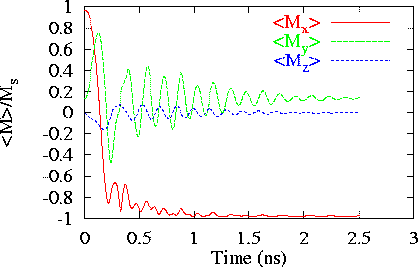
A plot of the spatially averaged magnetization calculated using 2 nm
cells.
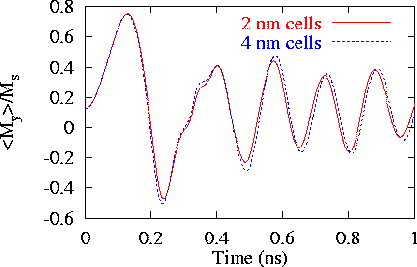
Comparison
of M vs. t data calculated with 2 nm cells and 4 nm cells. These
results demonstrate that the results cannot be entirely independent of
mesh size.
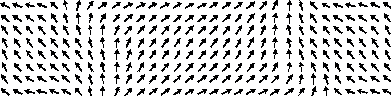
and an image of the magnetization when Mx
first crosses zero.
- For the second part of the problem, with the field applied
190° from the x-axis (Field 2):
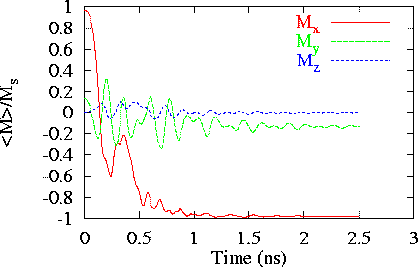
A plot of the
spatially averaged magnetization calculated with a 2 nm mesh.
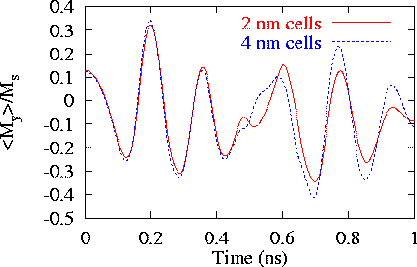
Comparison of M vs. t data calculated with 2 nm cells and 4 nm
cells.
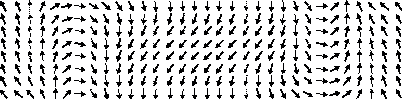
and an image of the magnetization when Mx
first crosses zero.
Raw data:
Time series data contain 4 columns: time (ns), M_x/M_s, M_y/M_s,
M_z/M_s. Vector data is in 6 columns: x, y, z
coordinates, and M_x/M_s, M_y/M_s, M_z/M_s vector
components.
References:
G.Albuquerque, J.Miltat and A.Thiaville, IMACS 2000 World Congress
Proceedings
G.Albuquerque, J.Miltat and A.Thiaville, Joint MMM-Intermag Conference 2001
(presentation)
Please send comments to [email protected] and join the
µMAG discussion e-mail list.
Site Directory
µMAG organization / NIST CTCMS /
[email protected]
11-NOV-2021