
OOF2: The Manual
Geographic (GeographicQ2T) |
||
|---|---|---|

|
6.5.2. Subclasses |  |
Name
Geographic (GeographicQ2T) — Split a quad based on its neighbors.
Synopsis
GeographicQ2T()
Description
GeographicQ2T is a SplitQuadMethod, used as the
split_how parameter in when splitting quadrilateral
Elements into triangles.
An interior quadrilateral has four neighboring Elements. If it has
two neighbors of one type (defined by their dominant pixel category) and
two of another, arranged as in Figure 6.80(a), and if the Element itself is
inhomogeneous, then there's a chance that dividing it along the
diagonal shown in Figure 6.80(b) will
improve the homogeneity of the Skeleton.
Figure 6.80. Splitting Quads Geographically
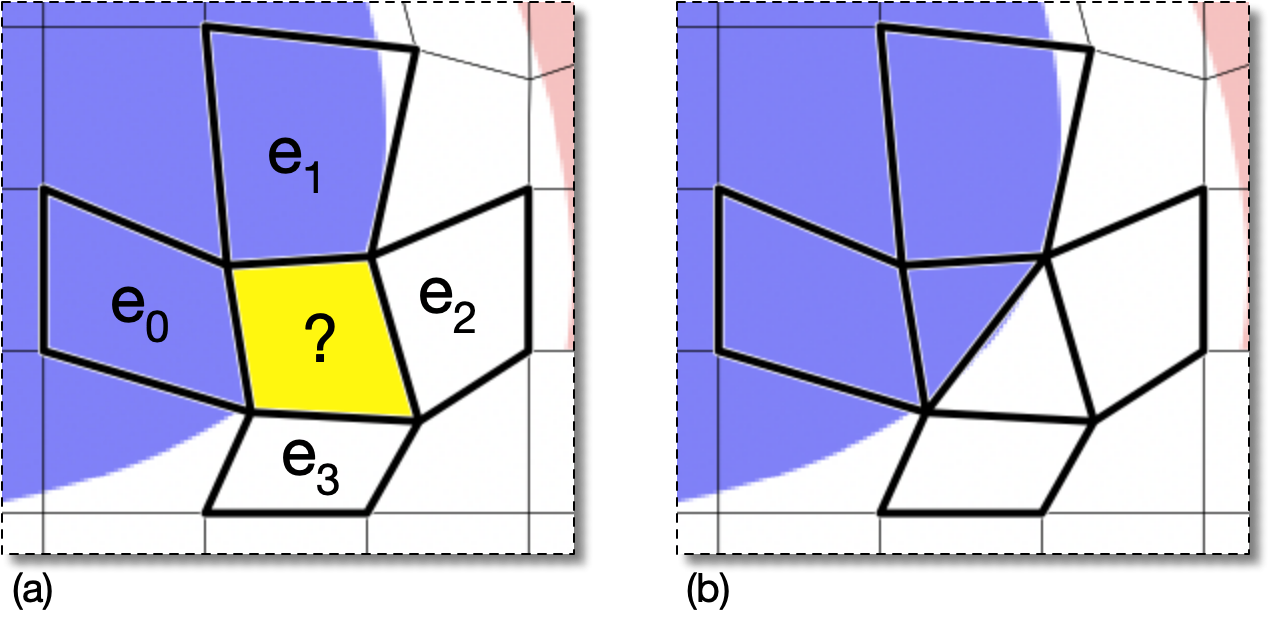
(a) A central Element (marked by the '?') and its neighbors
e0, e1,
e2, and e3. The
central element is a candidate for splitting with
GeographicQ2T because
e0 and e1 have
the same category, and e2 and
e3 have the same category. The
category of the central element is not a factor in the
decision to attempt to apply SplitQuads.
(b) New elements created by SplitQuads and
GeographicQ2T.
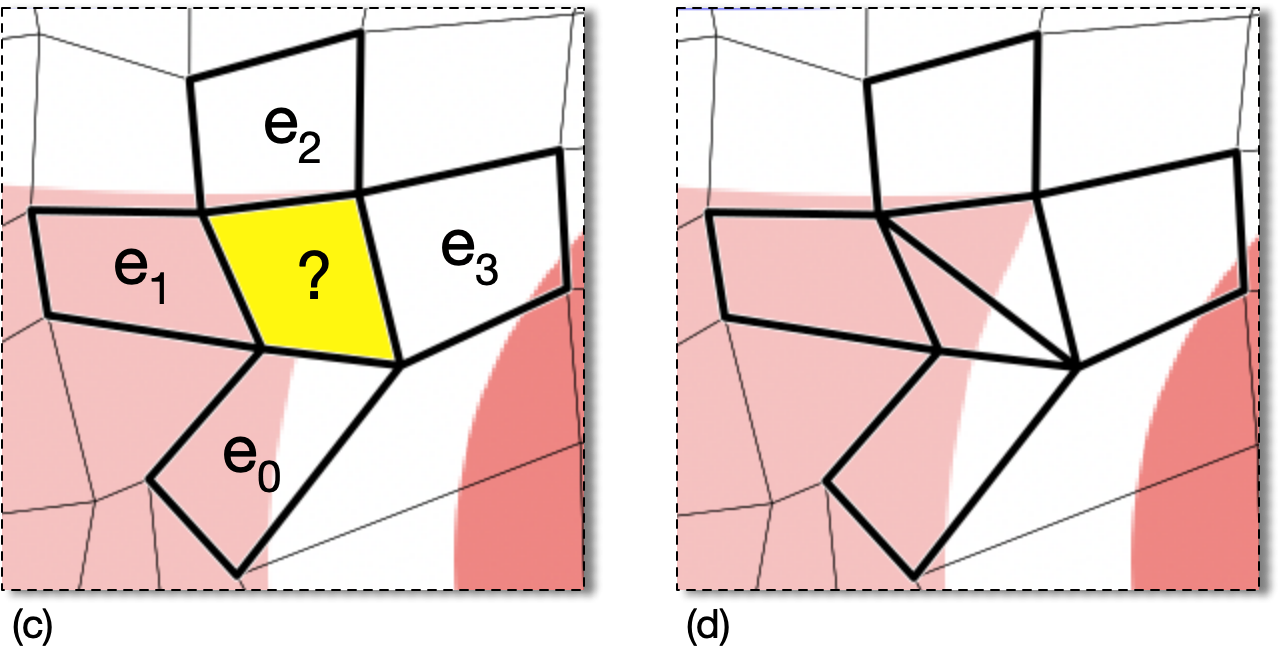
(c) In this example GeographicQ2T fails
to split the central element correctly, even though the
e0 and e1 have
the same pixel category (pink) and e2
and e3 have the same category (white).
(d) Dividing along the geographical boundary has created two
inhomogeneous Elements. This modification will be rejected
unless it was done with a very small alpha.
GeographicQ2T can be fast because it only
examines quads with a high likelihood of being splittable. However,
it can skip over splittable quads if the Skeleton is not already
sufficiently refined and one of the neighbors has the wrong
type. TrialAndErrorQ2T is slower
but more thorough.
|
|
 |
|
Generic (GenericReader)
|
 |
Geometric (Geometric) |