-
Citation: M.S. Daw, and M. Chandross (2023), "Simple parameterization of embedded atom method potentials for FCC metals", Acta Materialia 248, 118771. DOI: 10.1016/j.actamat.2023.118771.Abstract: We propose a simple parametric form for interatomic potentials of the Embedded Atom Method (EAM-X) for pure FCC metals, and study some of the basic properties as functions of input parameters. With this model, we deviate from the usual approach of fitting a set of functions to basic properties from experiments and/or density functional theory calculations, and then using those functions to investigate more complex properties. Instead, we illustrate here what we term the "inside out" approach, which seeks to understand generically how complex properties are dependent on the EAM-X parameters themselves. This method enables the identification of regions of parameter space that correspond to desirable attributes, and then the possibility of matching that neighborhood of parameters to real elements. A companion paper extends the model (and property studies) to FCC-based metal alloys.Citation: M.S. Daw, and M. Chandross (2023), "Simple Parameterization of Embedded Atom Method Potentials for FCC Alloys", Acta Materialia 248, 118772. DOI: 10.1016/j.actamat.2023.118772.Abstract: We extend our simple parametric form for Embedded Atom Method interatomic potentials for FCC metals [Daw & Chandross, "Simple Parameterization of Embedded Atom Method Potentials FCC Metals"] to treat alloys. Using this model, which we refer to as "EAM-X", we study the generic dependence of alloy properties on the model parameters. We introduce the idea of spread alloys, where the constituent elements are defined as parametric perturbations from a central, "average" FCC metal, and where different alloys are quantified by a measure of the magnitude of the perturbation. As an example, we consider a spread binary where the only differences between the constituent elements are lattice mismatch and the cross-interaction parameters and show that the model robustly describes the clustering and ordering tendencies of metal alloys. We use the model to prove a general theorem of "parametric simplicity" in random equimolar alloys: alloy properties differ from a simple rule of mixtures in a way that depends only on the standard deviation among the constituent parameters but are otherwise not dependent on the number of constituents, consistent with previous theoretical results.
Notes: EAM-X provides a simple EAM functional form with a small number of parameters allowing for explorations of how complex properties relate to the model parameterization. With EAM-X, models can be generated for real and fictional elements and alloys. This listing is for the meta-atom "Averagium" which has parameters that are the mean values of the canonical six elements.
-
LAMMPS pair_style eam/alloy (2023--Daw-M-S--meta-Cu-Ag-Au-Ni-Pd-Pt--LAMMPS--ipr1)See Computed Properties
Notes: This file was generated using the code found in the github repository and the parameters for the meta-atom element model Av found in the first citation. It was uploaded with permission from Michael Chandross and Murray Daw.
File(s): Link(s):github repository https://github.com/sandialabs/EAM-X-Potential-Generator
Implementation Information
Diatom Energy vs. Interatomic Spacing
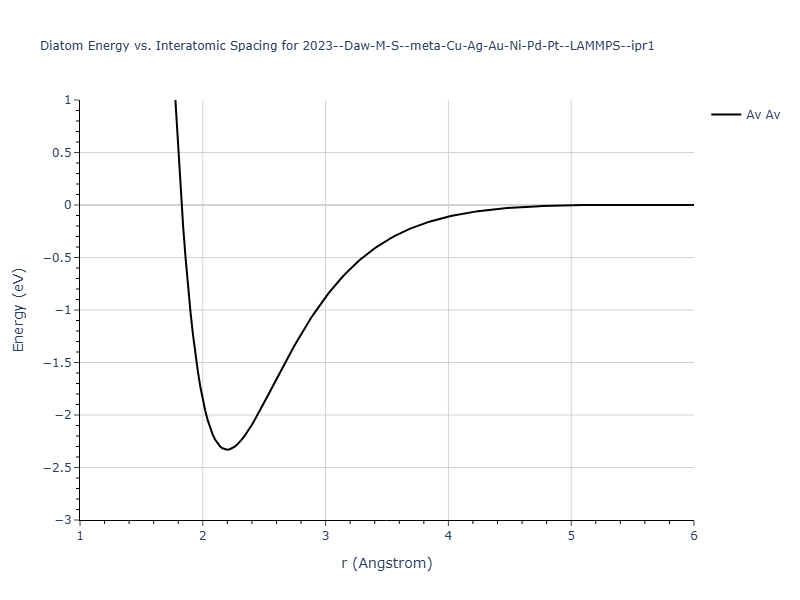
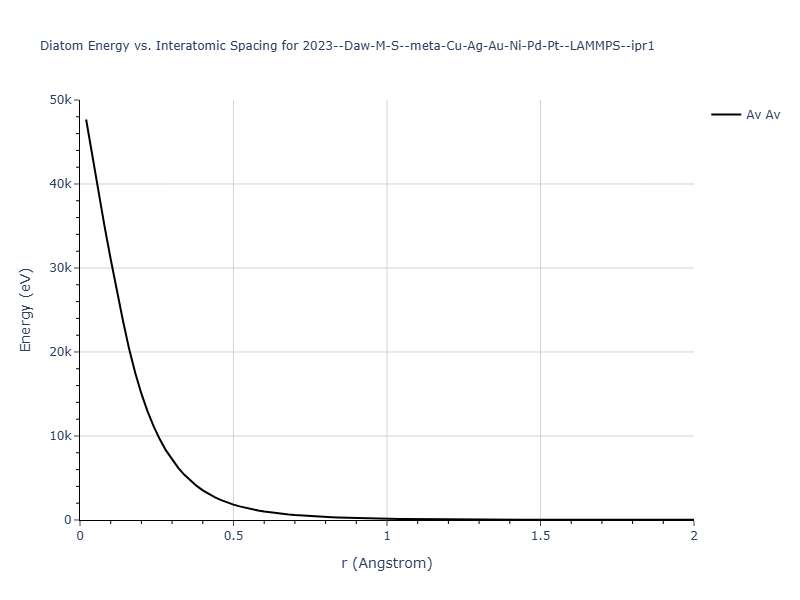
Plots of the potential energy vs interatomic spacing, r, are shown below for all diatom sets associated with the interatomic potential. This calculation provides insights into the functional form of the potential's two-body interactions. A system consisting of only two atoms is created, and the potential energy is evaluated for the atoms separated by 0.02 Å <= r <= 6.0> Å in intervals of 0.02 Å. Two plots are shown: one for the "standard" interaction distance range, and one for small values of r. The small r plot is useful for determining whether the potential is suitable for radiation studies.
The calculation method used is available as the iprPy diatom_scan calculation method.
Clicking on the image of a plot will open an interactive version of it in a new tab. The underlying data for the plots can be downloaded by clicking on the links above each plot.
Notes and Disclaimers:
- These values are meant to be guidelines for comparing potentials, not the absolute values for any potential's properties. Values listed here may change if the calculation methods are updated due to improvements/corrections. Variations in the values may occur for variations in calculation methods, simulation software and implementations of the interatomic potentials.
- As this calculation only involves two atoms, it neglects any multi-body interactions that may be important in molecules, liquids and crystals.
- NIST disclaimer
Version Information:
- 2019-11-14. Maximum value range on the shortrange plots are now limited to "expected" levels as details are otherwise lost.
- 2019-08-07. Plots added.
Click on plot to load interactive version
Click on plot to load interactive version
Cohesive Energy vs. Interatomic Spacing
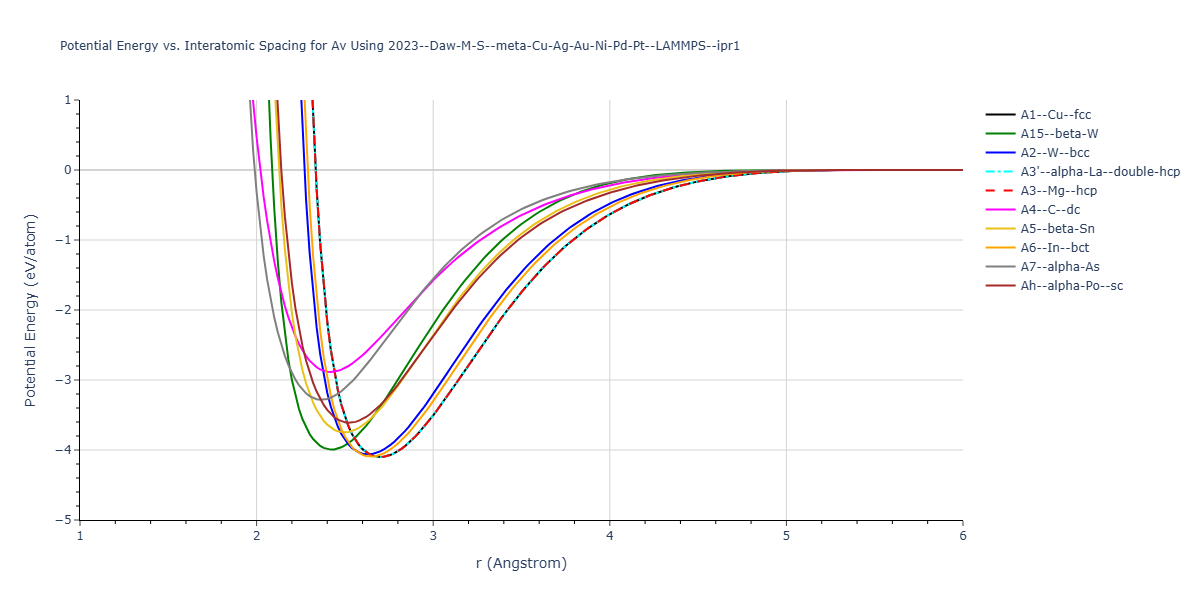
Plots of potential energy vs interatomic spacing, r, are shown below for a number of crystal structures. The structures are generated based on the ideal atomic positions and b/a and c/a lattice parameter ratios for a given crystal prototype. The size of the system is then uniformly scaled, and the energy calculated without relaxing the system. To obtain these plots, values of r are evaluated every 0.02 Å up to 6 Å.
The calculation method used is available as the iprPy E_vs_r_scan calculation method.
Clicking on the image of a plot will open an interactive version of it in a new tab. The underlying data for the plots can be downloaded by clicking on the links above each plot.
Notes and Disclaimers:
- These values are meant to be guidelines for comparing potentials, not the absolute values for any potential's properties. Values listed here may change if the calculation methods are updated due to improvements/corrections. Variations in the values may occur for variations in calculation methods, simulation software and implementations of the interatomic potentials.
- The minima identified by this calculation do not guarantee that the associated crystal structures will be stable since no relaxation is performed.
- NIST disclaimer
Version Information:
- 2020-12-18. Descriptions, tables and plots updated to reflect that the energy values are the measuredper atom potential energy rather than cohesive energy as some potentials have non-zero isolated atom energies.
- 2019-02-04. Values regenerated with even r spacings of 0.02 Å, and now include values less than 2 Å when possible. Updated calculation method and parameters enhance compatibility with more potential styles.
- 2019-04-26. Results for hcp, double hcp, α-As and L10 prototypes regenerated from different unit cell representations. Only α-As results show noticable (>1e-5 eV) difference due to using a different coordinate for Wykoff site c position.
- 2018-06-13. Values for MEAM potentials corrected. Dynamic versions of the plots moved to separate pages to improve page loading. Cosmetic changes to how data is shown and updates to the documentation.
- 2017-01-11. Replaced png pictures with interactive Bokeh plots. Data regenerated with 200 values of r instead of 300.
- 2016-09-28. Plots for binary structures added. Data and plots for elemental structures regenerated. Data values match the values of the previous version. Data table formatting slightly changed to increase precision and ensure spaces between large values. Composition added to plot title and structure names made longer.
- 2016-04-07. Plots for elemental structures added.