Remanent magnetization along the long axis of the particle as a
function of d/lex.
Remanent magnetization along the short axis of the particle as
a function of d/lex.
Solution to standard problem #2 From: B Streibl, T Schrefl and J Fidler Contact: T Schrefl
Reference: B. Streibl, T. Schrefl and J. Fidler,
J. Appl. Phys, v. 85, pp 5819-5821 (1999).
We studied standard problem #2 using a 3D-finite element simulation
based on the solution of the Gilbert equation. Asymptotic boundary conditions
were imposed in order to compute demagnetizing fields. The direction cosines
of the magnetization and the magnetic scalar potential were interpolated
with piecewise linear and quadratic polynomials on hexahedral finite elements,
respectively. The finest mesh used for the calculations contains 500 elements
within the magnetic thin film and 4200 in the exterior space. The values
of Permalloy were assumed for the magnetization and the exchange
constant, so that the exchange length lex becomes 5 nm. (The coordinate axis are oriented as proposed in the specification
of the standard problem) (lex denotes the exchange length) Contact: Bob McMichael
Reference: R. D. McMichael, M. J. Donahue, D. G. Porter and Jason Eicke,
J. Appl. Phys, v. 85, pp 5816-5818 (1999).
We used the OOMMF 1.0 public code
to compute solutions to standard problem #2. The mesh was a 2D square
grid with 3D spins interacting through an 8-neighbor exchange
representation and magnetostatic fields. Computations were done for a
number of mesh sizes, using up to 12500 cells, using energy minimization
(precession neglected). We obtained similar results for two methods of
calculating the magnetostatic fields, the constant magnetization method,
and the constant charge method.
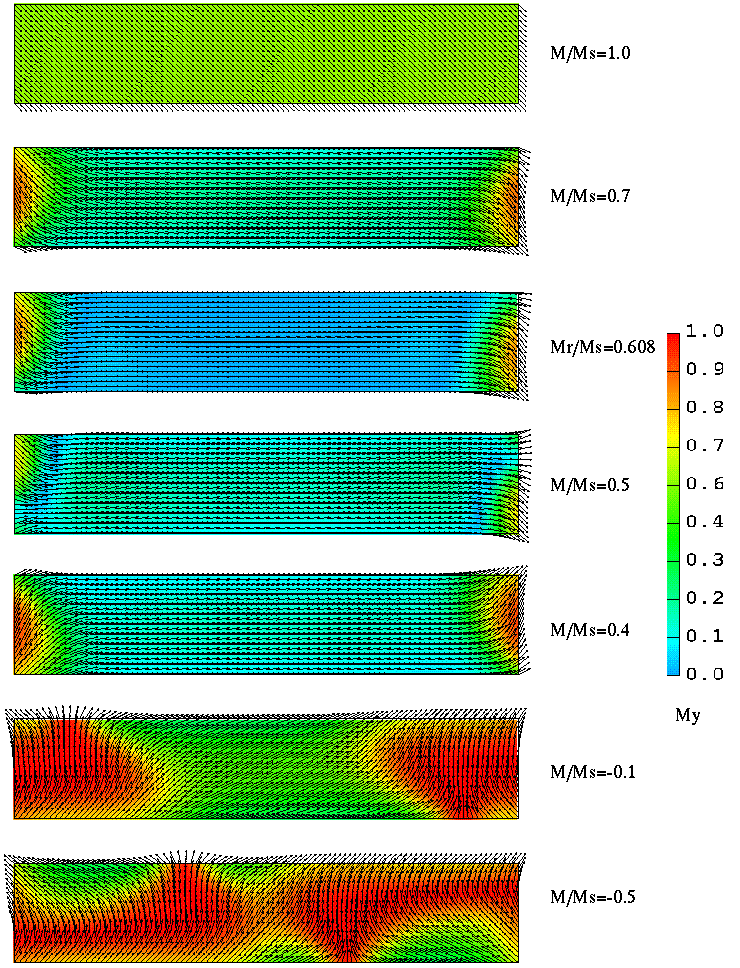
We find three types of critical fields, end domain switching, end domain
propagation, and vortex formation, depending on the value of
d/lex. These critical field values, extrapolated to
zero cell size, are listed below in terms of
Hc/Ms with an uncertainty of plus/minus
0.0014, corresponding to the field step size.
The remanent magnetization values, calculated by relaxing from
saturation in the (111) direction are also listed.
Coercivity for fields applied along the (111) direction
as a function of d/lex.
Submitted Solution
Institute of Applied and Technical Physics
Vienna University of Technology
Wiedner Hauptstr. 8-10
A-1040 Vienna, Austria
URL:
http://magnet.atp.tuwien.ac.at/
A Gilbert-damping parameter (alpha=1) was used to drive the system towards
equilibrium. For more details on the calculation method we refer to our
forthcoming paper "Dynamic FE-simulation of mumag standard problem
#2" which will be presented at the 43rd annual conference on Magnetism
& Magnetic Materials in Miami, November 9-12, 1998 (session FZ-05).
d/lex
Mrx/Ms
Mry/Ms
Mrz/Ms
Hc/Ms
1
0.999
0.029
-0.004
-0.056
5
0.999
0.006
0.000
-0.056
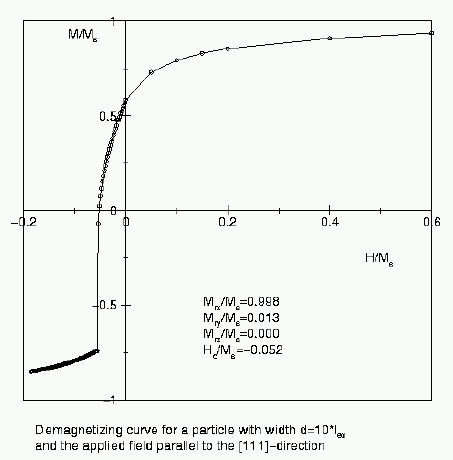
10
0.998
0.020
0.000
-0.054
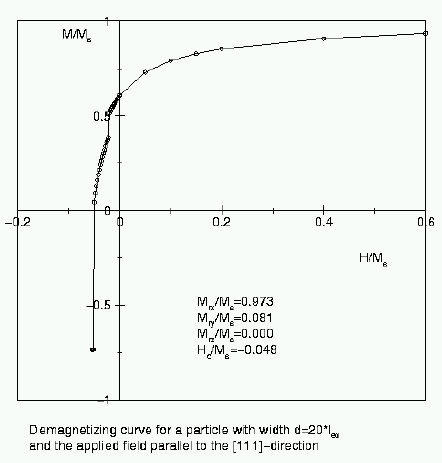
20
0.973
0.081
0.000
-0.050
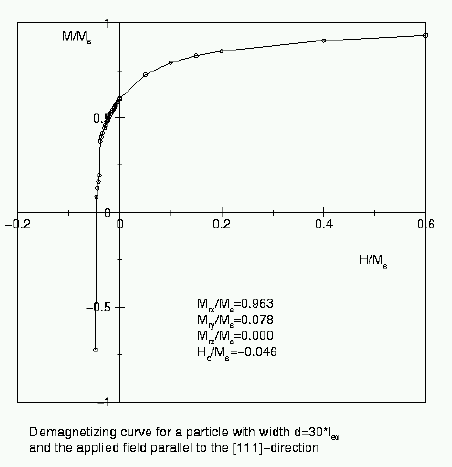
30
0.963
0.078
0.000
-0.046
(M denotes the component of the magnetization parallel to the field)
Submitted Solution
R. D. McMichael, M. J. Donahue, and D. G. Porter
National Institute of Standards and Technology, Gaithersburg, MD 20899
J. Eicke
Institute for Magnetics Research,
George Washington University, Washington, DC 20052
|
|
|
|||||
| d/lex | end propagation | end switch | vortex formation | Mx/Ms | My/Ms | Mz/Ms |
| 3.16 | 0.0600 | 1.0000 | 0.0007 | 0.0000 | ||
| 10 | 0.0586 | 0.0007 | 0.9959 | 0 .0376 | -0.0000 | |
| 14 | 0.0558 | 0.0145 | 0.9783 | 0.0822 | 0.0000 | |
| 17.8 | 0.0531 | 0.0278 | 0.9711 | 0.0851 | 0.0000 | |
| 23 | 0.0503 | 0.0393 | 0.9657 | 0.0823 | 0.0000 | |
| 27 | 0.0489 | 0.0448 | 0.9631 | 0.0792 | 0.0000 | |
| 31.6 | 0.0517 | 0.9609 | 0.0760 | 0.0000 | ||
| 35 | 0.0553 | 0.9595 | 0.0739 | 0.0000 | ||
| 40 | 0.0532 | 0.9577 | 0.0710 | 0.0000 | ||
| 56 | 0.0408 | 0.9527 | 0.0638 | 0.0000 | ||
| 75 | 0.0200 | 0.9478 | 0.0572 | 0.0003 | ||
Contact: Luis Lopez Diaz
Reference: L. Lopez-Diaz, O. Alejos, L. Torres and J. I. Iniguez J. Appl. Phys, v. 85, pp 5813-5815 (1999).
| d/lex | Hc/Ms | M[111] | Mrx | Mry |
| 0.8 | 0.0631 | 0.5773740 | 1.00000 | 7.00000E-05 |
| 1.0 | 0.0612 | 0.5773501 | 1.00000 | 7.00000E-05 |
| 2.0 | 0.0594 | 0.5773470 | 0.999996 | 4.27499E-05 |
| 3.0 | 0.0596 | 0.5773384 | 0.999981 | -1.24466E-07 |
| 4.0 | 0.0594 | 0.5773172 | 0.999942 | 4.14687E-05 |
| 5.0 | 0.0592 | 0.5772781 | 0.999876 | 3.95000E-05 |
| 6.0 | 0.0585 | 0.5772195 | 0.999777 | -7.30804E-08 |
| 7.0 | 0.0583 | 0.5771367 | 0.999596 | 8.22480E-08 |
| 8.0 | 0.0580 | 0.5770244 | 0.999439 | 3.25319E-05 |
| 9.0 | 0.0576 | 0.5769020 | 0.999191 | 6.88017E-05 |
| 10.0 | 0.0573 | 0.5956421 | 0.996272 | 3.54161E-02 |
| 11.0 | 0.0568 | 0.6069226 | 0.989998 | 6.12417E-02 |
| 12.0 | 0.0565 | 0.6106740 | 0.985207 | 7.25276E-02 |
| 13.0 | 0.0560 | 0.6120005 | 0.981448 | 7.85834E-02 |
| 14.0 | 0.0556 | 0.6122172 | 0.978436 | 8.19699E-02 |
| 15.0 | 0.0549 | 0.6118625 | 0.975986 | 8.38084E-02 |
| 16.0 | 0.0541 | 0.6112075 | 0.973947 | 8.47102E-02 |
| 17.0 | 0.0534 | 0.6103936 | ||
| 18.0 | 0.0529 | 0.6095005 | 0.970768 | 8.49321E-02 |
| 20.0 | 0.0518 | 0.6076426 |
Contact: Mike Donahue
(URL: http://math.nist.gov/mcsd/Staff/MDonahue/)
Reference: J. Appl. Phys, .v 87, pp. 5520-5522 (2000).
An examination of the coercive fields from first three submissions (Streibl et al., McMichael et al., Diaz et al.) reveals discrepancies in the small particle limit (d/lex near 0). In this range the magnetization is nearly uniform, so we performed a 3D Stoner-Wohlfarth analysis, and found the theoretical value for the coercive field to be Hc/Ms = 0.05707. This result is in close agreement with the Streibl submission, but is removed from our first calculation (McMichael), which was based on version 1.0 of the OOMMF public code.
In the uniformly magnetized setting, only magnetostatic energies are active. We therefore examined the demagnetization (self-magnetostatic) energy calculated by OOMMF as a function of calculation cell size for the uniformly magnetized particle. It is observed that the sampled Hdemag model used in OOMMF 1.0 for demagnetization energy calculations is inaccurate in this case.
The magnetostatic energy between two uniformly magnetized rectangular prisms can be evaluated analytically (A. J. Newell, W. Williams, and D. J. Dunlop, J. Geophysical Research, 98, 9551 (1993)). From the standpoint of calculating demagnetization energy, these formulae can be viewed as providing a value for Hdemag that has been averaged over the calculation cell. The averaged Hdemag model is also completely accurate for uniformly magnetized particles (as seen in the aforementioned graph).
In the small particle range, the accuracy of the averaged Hdemag formulae allowed us to use calculation cells that were large compared to d. We could then run simulations at smaller values of d/lex than we had in our earlier submission. We discovered, however, that numerical errors in the calculation of the exchange energy produced an artificial stiffening of the simulation. We were able to reduce this problem by replacing our base exchange energy term 1-mi·mk (mi and mk are neighboring spins) with an expression of the form mi·(mi - mk).
These changes have been incorporated into version 1.1 of OOMMF, which was used to produce this submission. From the summary coercive field plot above, we see that OOMMF 1.1 closely tracks the Streibl results, and agrees with the theoretical result for the infinitely small particle case.
It is worth noting that the switching field Hs (the field at which the first irreversible change in magnetization occurs) is somewhat larger that the coercive field Hc (the field at which Happlied·M =0) for d/lex<15, as illustrated by this graph. We found that the theoretical value for the switching field in the small particle limit was Hs/Ms = 0.05714, also slightly higher than the coercive field.
The table below presents our results using OOMMF 1.1 with the changes outlined above. Hc is the coercive field, Hs is the switching field, Mx and My are the average x and y magnetizations at remanence. MaxAngle/run is the largest angle between neighboring spins (i.e., calculation elements) that occurred throughout the simulation, including non-equilibrium states; this is an indication of the ability of the sample mesh to represent the variation in the magnetization. The uncertainty in the field values Hc and Hs due to the applied field step size is less than ±0.0000138 Ms. In particular, the results at d/lex=0.125 agree to within this precision with the theoretical results for an infinitely small particle.
| d/lex | Cellsize/
lex |
Hc/Ms | Hs/Ms | Mx/Ms | My/Ms | MaxAngle/
run (deg) |
| 30 | 0.60 | 0.04594 | 0.04594 | 0.9627 | 0.0756 | 13.4 |
| 29 | 0.58 | 0.04630 | 0.04630 | 0.9632 | 0.0763 | 12.8 |
| 28 | 0.56 | 0.04666 | 0.04666 | 0.9638 | 0.0769 | 12.2 |
| 27 | 0.54 | 0.04704 | 0.04704 | 0.9644 | 0.0776 | 11.6 |
| 26 | 0.52 | 0.04740 | 0.04740 | 0.9650 | 0.0783 | 11.0 |
| 25 | 0.50 | 0.04779 | 0.04779 | 0.9657 | 0.0790 | 10.4 |
| 24 | 0.48 | 0.04817 | 0.04817 | 0.9664 | 0.0797 | 9.75 |
| 23 | 0.46 | 0.04859 | 0.04859 | 0.9672 | 0.0803 | 9.16 |
| 22 | 0.44 | 0.04903 | 0.04903 | 0.9680 | 0.0809 | 8.57 |
| 21 | 0.42 | 0.04947 | 0.04947 | 0.9690 | 0.0814 | 7.98 |
| 20 | 0.40 | 0.04991 | 0.04991 | 0.9701 | 0.0819 | 7.41 |
| 19 | 0.38 | 0.05041 | 0.05041 | 0.9713 | 0.0822 | 6.85 |
| 18 | 0.36 | 0.05090 | 0.05090 | 0.9727 | 0.0822 | 6.31 |
| 17 | 0.34 | 0.05145 | 0.05145 | 0.9743 | 0.0819 | 5.77 |
| 16 | 0.32 | 0.05200 | 0.05200 | 0.9762 | 0.0811 | 5.25 |
| 15 | 0.30 | 0.05258 | 0.05261 | 0.9784 | 0.0795 | 4.73 |
| 14 | 0.56 | 0.05309 | 0.05324 | 0.9812 | 0.0765 | 8.4 |
| 13 | 0.52 | 0.05352 | 0.05388 | 0.9845 | 0.0716 | 7.5 |
| 12 | 0.48 | 0.05389 | 0.05449 | 0.9886 | 0.0631 | 6.8 |
| 11 | 0.44 | 0.05423 | 0.05506 | 0.9938 | 0.0463 | 6.1 |
| 10 | 0.40 | 0.05454 | 0.05562 | 0.9989 | 0.0000 | 5.1 |
| 9 | 0.45 | 0.05480 | 0.05614 | 0.9992 | 0.0000 | 4.0 |
| 8 | 0.40 | 0.05515 | 0.05661 | 0.9995 | 0.0000 | 4.0 |
| 7 | 0.35 | 0.05546 | 0.05702 | 0.9996 | 0.0000 | 3.2 |
| 6 | 0.30 | 0.05579 | 0.05730 | 0.9998 | 0.0000 | 2.4 |
| 5 | 0.25 | 0.05612 | 0.05741 | 0.9999 | 0.0000 | 1.8 |
| 4 | 0.20 | 0.05646 | 0.05735 | 0.9999 | 0.0000 | 1.2 |
| 3 | 0.15 | 0.05674 | 0.05724 | 1.0000 | 0.0000 | 0.696 |
| 2 | 0.10 | 0.05694 | 0.05716 | 1.0000 | 0.0000 | 0.314 |
| 1 | 0.05 | 0.05704 | 0.05716 | 1.0000 | 0.0000 | 0.079 |
| 0.75 | 0.15 | 0.05705 | 0.05713 | 1.0000 | 0.0000 | 0.182 |
| 0.50 | 0.10 | 0.05706 | 0.05713 | 1.0000 | 0.0000 | 0.0813 |
| 0.25 | 0.05 | 0.05707 | 0.05713 | 1.0000 | 0.0000 | 0.0204 |
| 0.125 | 0.03 | 0.05707 | 0.05713 | 1.0000 | 0.0000 | 0.0063 |
| Theory | n/a | 0.05707 | 0.05714 | 1.0000 | 0.0000 | n/a |