 FiPy
FiPyNumerical Schemes
The coefficients of equation (6) must remain positive,
since an increase in a neighboring value must result in an increase in
 to obtain physically realistic solutions. Thus, the
inequalities
to obtain physically realistic solutions. Thus, the
inequalities  and
and  must be satisfied. The
Péclet number
must be satisfied. The
Péclet number  is the ratio between convective
strength and diffusive conductance. To achieve physically realistic
solutions, the inequality
is the ratio between convective
strength and diffusive conductance. To achieve physically realistic
solutions, the inequality
(1)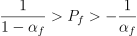
must be satisfied.
The parameter  is defined by the chosen scheme, depending
on Equation (1). The various
differencing schemes are:
is defined by the chosen scheme, depending
on Equation (1). The various
differencing schemes are:
- the central differencing scheme,
where
(2)

so that
 satisfies Equation (1). Thus, the
central differencing scheme is only numerically stable for a low
values of
satisfies Equation (1). Thus, the
central differencing scheme is only numerically stable for a low
values of  .
.- the upwind scheme,
where
(3)
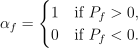
Equation (3) satisfies the inequality in Equation (1) for all values of
. However the
solution over predicts the diffusive term leading to excessive
numerical smearing (“false diffusion”).- the exponential scheme,
where
(4)
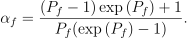
This formulation can be derived from the exact solution, and thus, guarantees positive coefficients while not over-predicting the diffusive terms. However, the computation of exponentials is slow and therefore a faster scheme is generally used, especially in higher dimensions.
- the hybrid scheme,
where
(5)
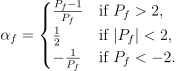
The hybrid scheme is formulated by allowing
 ,
,
 and
and  in the exponential
scheme. The hybrid scheme is an improvement on the upwind scheme,
however, it deviates from the exponential scheme at
in the exponential
scheme. The hybrid scheme is an improvement on the upwind scheme,
however, it deviates from the exponential scheme at  .
.- the power law scheme,
where
(6)
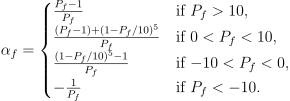
The power law scheme overcomes the inaccuracies of the hybrid scheme, while improving on the computational time for the exponential scheme.
Warning
VanLeerConvectionTerm not
mentioned and no discussion of explicit forms.
All of the numerical schemes presented here are available in FiPy and can be selected by the user.